Bookworm: A thoughtful reading companion.
Bookworm is the reading journal for people who want to actually remember what they read and understand why it mattered. Not a tracker. Not a social network. A private, thoughtful companion for your reading life.
Overview
Bookworm is a fictional web application I have created to practice and demonstrate my AI-augmented product development skills. The linked artifacts have been assembled through collaboration with Claude (including Code & Design), ChatPRD, Napkin, and other similar tools where noted. The ideas, synthesis, and design direction are my own.

The Project Thesis
The reading app category is built around counting books. Nobody is built around understanding them.
Every major player in the space from Goodreads to StoryGraph to Fable measures reading quantitatively: pages, books, time, streaks.
The qualitative layer that is reflection, meaning-making, and person al growth is either absent or buried in a text field. This isthe white space Bookworm can own, and no incumbent is structurally able to follow.

Requirements + Design
I started out by writing a product requirements document. First, I based my draft on my own experience as a product manager, then I refined the draft with Claude and ChatPRD in a quest to understand best practices for handing off the artifact to AI for coding.
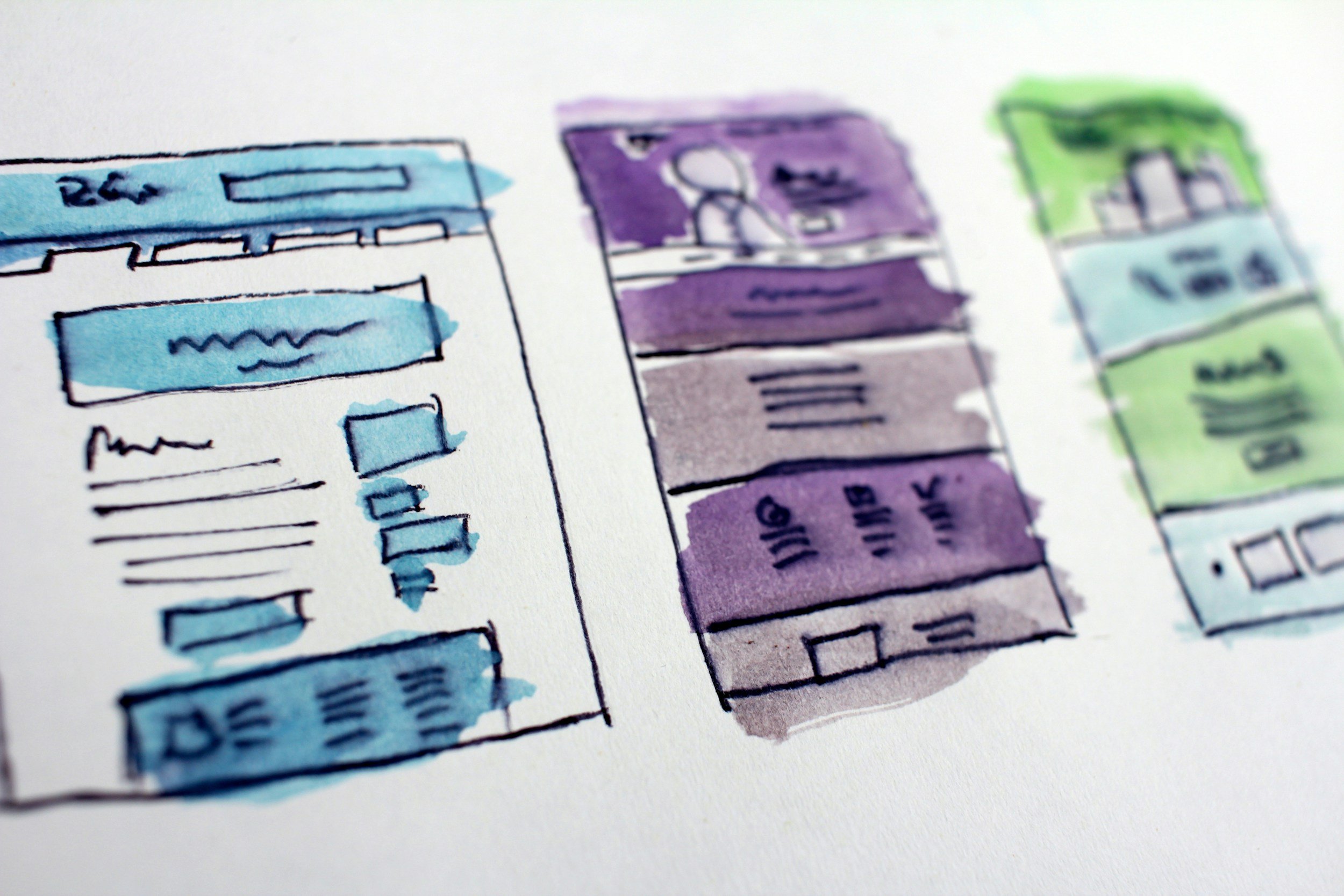
Next I worked through the application UI and UX design using the PRD. I tried generating designs both in Figma Make and Claude Design. The goal here was to practice working with both tools and create a markdown file of the design plan to Claude Code.

Business Case + Go-to-Market
Most product folks would start here, and if my core objective was a real product I would too (I promise). However since my original goal was up-skilling on AI for development I instead looped back to the business strategy pieces. Or more accurately I worked on these in parallel while Claude Code was doing it’s thing.
I used Claude as my research companion and assistant to pull together market information, summarize thoughts and ideas, and create the traditional top-of-funnel and go-to-market artifacts that take a product from idea to reality.
The section below contains all of the research and strategic planning to make Bookworm a real, market ready product.
Ideation
Bookworm came about due to personal dissatisfaction with the book tracking app options and the lack of smart features with analog journals.
I wanted to start vibe-coding with a project that felt meaningful to me. I read 3-4 books a month and I think critically about each one as I go. Keeping up with my reading habit using a physical journal wasn’t cutting it. The apps I heard about on social media didn’t get at what made tracking reading hard for me. So I decided to do what everyone does in 2026, build a custom solution myself.
Build + Refine
I worked with Claude Code to start building my web application using markdown files for both the requirements/scoping document and the design elements/interaction behavior.
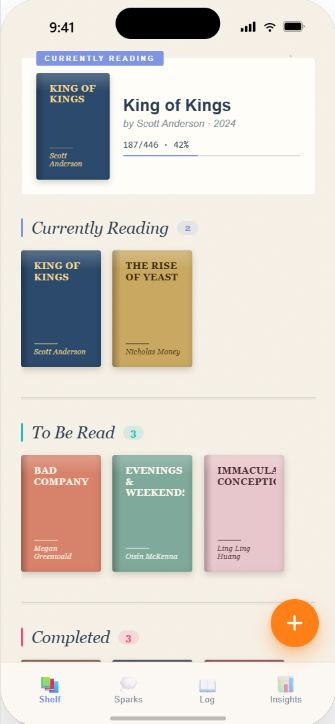
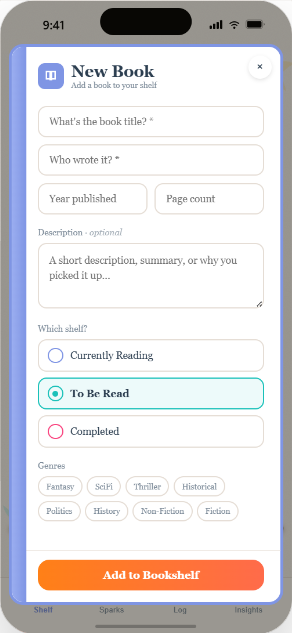
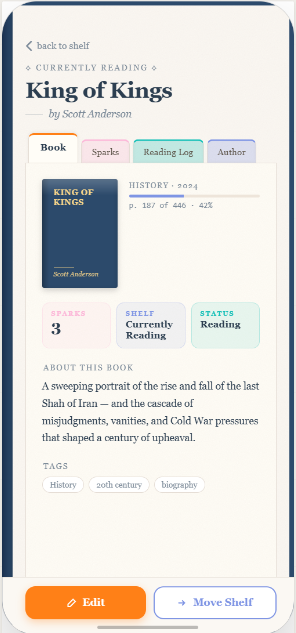
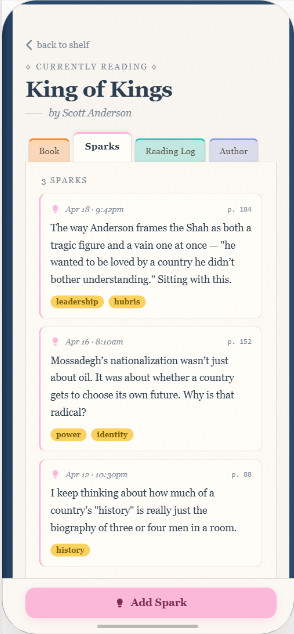
The first pass was structuring the application framework and major architectural decisions - starting with a single user, locally hosted application. Then I began the data layer which would store the book, author, reading log, and reflections data. Next was building out the core screens like the digital shelf, book and author capture, and a lightweight reflection and reading log. The final step - so far - was cleaning up the user experience and animations to make it all cohesive.

-
![]()
Home Screen
-
![]()
Add a Book
-
![]()
Book Details
-
![]()
Sparks
Artifacts
-
![]()
Market & User Research
An overview of who the competitive landscape, target user personas, and opportunity space.
-
![]()
Product Requirements Document
The business context, MVP feature scope, and requirements for the initial build.